On friendship:
I don't know if I want friendship with anyone else at any point prior to a friendship "happening". It's kind of something that happens. I NEVER start off with "friendship" as a goal. Mostly I pursue doing things with others who motivate me because I don't do much of anything outside of my "stirring mud puddles" unless there is someone else involved with whom I experience that sense of "wanting to do" something ... out of which friendship sometimes happens, but mostly it doesn't (EXTREMELY rare when it does ... to which I would add, thank god!) ... and I am always surprised when it does. And that's due in great part to my not pursuing friendship except when lo and behold it's there, already happening.
In examining my friendships as a result of this dialog between us, I think I am drawn to those who who make me think more deeply about things I want to think about, and who are able to motivate me to do stuff with them ... "stuff" that is interesting and "worthwhile" to do (in my estimation of these things)... stuff that stimulates my mind. For instance, as to group activity, I don't enjoy dancing. Nor do I enjoy something like building a house for low income families with other like-minded individuals.
These examples—dancing and building houses for low income families—are taken from real life ... my life. People I know and admire enjoy both of these activities. I don't. It used to be that I would try to accommodate their interests, then I learned it is better to find the mutually enjoyable activities and do those things together. But sometimes it is difficult to convince someone that I really don't enjoy (to look forward to or to participate in) some activities ... and that I do enjoy the other person in the mutually compatible activities.
On enlightenment:
No, I don't believe I have achieved "enlightenment" on any other level than my own personal satisfaction with who I am and what I "have". And the very real sense my life has been full and complete ... I don't have ANY "I wish I would have been able to do that's" in my life. And it is because (I think) I made choices that I wanted to make ... and took the consequences, tried to "carry my own water", as Nick Nolte's character said in one of his movies.
I have absolutely no doubt that as long as I continue to live and can retain my ability to reason, I will continue to live this way ... in this sense I will continue to grow and change, because that is living.
On regrets:
Some of my choices have brought pain to others whom I loved and cared about. I do regret that. The alternative--I believe--was to remain imprisoned in the expectations of others. I chose to be free. I don't regret that choice.
On the nature of the cosmos:
I accept chaos theory and the "proof" of the inherent complexity of the cosmos as expressed in fractal mathematics. The flapping of the butterfly's wings does make a difference. But it is not for the butterfly in China to try to control the hurricane in the Caribbean, it is for the butterfly to flap its wings.
Chaos theory and fractals allow me to believe that the cosmos (the totality of what we know and don't know about "what is") has the inherent complexity required to produce life. As we existentialists say, it doesn't matter whether God exists or not. There is enough here to explain what's going on without resorting to God. In fact, if God does exist then we have more philosophical problems (conundrums) to deal with than if he/she doesn't exist.
And in trying to resolve these conundrums stemming from a belief in a God, we tie ourselves in social knots ... when simply being human beings would be so much more satisfying and enjoyable.
Chaos theory
From Wikipedia, the free encyclopedia.
In mathematics and physics, chaos theory deals with the behavior of certain nonlinear dynamic systems that under certain conditions exhibit a phenomenon known as chaos, which is characterized by a sensitivity to initial conditions (see butterfly effect). As a result of this sensitivity, the behavior of systems that exhibit chaos appears to be random, even though the model of the system is deterministic in the sense that it is well defined and contains no random parameters. Examples of such systems include the atmosphere, the solar system, plate tectonics, turbulent fluids, economies, and population growth.
Systems that exhibit mathematical chaos are deterministic and thus orderly in some sense; this technical use of the word chaos is at odds with common parlance, which suggests complete disorder. See the article on mythological chaos for a discussion of the origin of the word in mythology, and other uses. Chaos theory deals with deterministic systems, and a related field of physics called quantum chaos theory studies non-deterministic systems that follow the laws of quantum mechanics.
Butterfly effect
From Wikipedia, the free encyclopedia.
The butterfly effect is a phrase that encapsulates the more technical notion of sensitive dependence on initial conditions in chaos theory. The idea is that small variations in the initial conditions of a dynamical system produce large variations in the long term behavior of the system. Sensitive dependence is also found in non-dynamical systems: for example, a ball placed at the crest of a hill might roll into any of several valleys depending on slight differences in initial position.
The practical consequence of the butterfly effect is that complex systems such as the weather are difficult to predict past a certain time range - approximately a week, in the case of weather. This is because any finite model that attempts to simulate a system must necessarily truncate some information about the initial conditions—for example, when simulating the weather, one would not be able to include the wind coming from every butterfly's wings. In all practical cases, defects in the knowledge of the initial conditions and deficiencies in the model are equally important sources of error. In a chaotic system, these errors are magnified as the simulation progresses. Thus the predictions of the simulation are useless after a certain finite amount of time.
Edward Lorenz first analyzed the effect in a 1963 paper for the New York Academy of Sciences. According to the paper, "One meteorologist remarked that if the theory were correct, one flap of a seagull's wings could change the course of weather forever." Later speeches and papers by Lorenz used the more poetic butterfly, possibly inspired by the diagram generated by the Lorenz attractor, which looks like a butterfly; other theories propose that the phrase's basis is to be found in fiction (Ray Bradbury's 1952 story "A Sound of Thunder"), but there is no proof available that Lorenz was swayed by literary precedent. The idea is now often stated something to the effect of, “a butterfly flapping its wings in Tokyo could cause tornadoes in California.”
Fractal
From Wikipedia, the free encyclopedia.
A fractal is a geometric object which is rough or irregular on all scales of length, and therefore appears to be 'broken up' in a radical way. Fractals can be most simply defined as images that can be divided into parts, each of which is similar to the original object. Fractals are said to possess infinite detail, and some of them have a self-similar structure that occurs at different scales, or levels of magnification. In many cases, a fractal can be generated by a repeating pattern, in a typically recursive or iterative process. The term fractal was coined in 1975 by Benoît Mandelbrot, from the Latin fractus or "broken". Before Mandelbrot coined his term, the common name for such structures (the Koch snowflake, for example) was monster curve.
Fractals of many kinds were originally studied as mathematical objects. Fractal geometry is the branch of mathematics which studies the properties and behavior of fractals. It describes many situations which cannot be explained easily by classical geometry, and has often been applied in science, technology, and computer-generated art. The conceptual roots of fractals can be traced to attempts to measure the size of objects for which traditional definitions based on Euclidean geometry or calculus fail.
The most characteristic property of fractals is that they are generally irregular (not smooth) in shape, and thus are not objects definable by traditional geometry. That means that fractals tend to have significant detail, visible at any arbitrary scale; when there is self-similarity, this can occur because magnification simply shows similar pictures. Such sets are usually defined instead by recursion.
...
For example, a normal Euclidean shape, such as a circle, looks flatter and flatter as it is magnified. At infinite magnification it would be impossible to tell the difference between the circle and a straight line. Fractals do not exhibit this property. The conventional idea of curvature, which represents the reciprocal of the radius of an approximating circle, cannot usefully apply because it scales away. Instead, with a fractal, increasing the magnification reveals more detail that was previously invisible.
My thoughts:
What I like about chaos theory is the idea of how even the smallest event at the beginning of a chain of events can hugely affect the outcome ... without the "actor" in the beginning event having any real control over the outcome in the sense of "knowing" or "planning" the outcome. The role of the butterfly is to flap its wings, not plan hurricanes in the Caribbean or wind storms in California. Translated into my existence, I do not know the effect my life will have on the cosmos. I simply must be who I am. That is enough for my part in the unfolding cosmos.
What I like about fractals is the coherent complexity at all levels. Life is like that. To me it means that the cosmos has an inherent capacity for the complexity of life. So the question is pushed back to,Where did the cosmos come from? or, has it "always" been? I experience existence as coming out of what was and going into what will be. My awareness of the experience of my existence is my realm of being. I existed prior to my awareness of my existence, and my awareness is formed by my existence ... in any case I am aware of a capacity to choose, and in choosing out of all the choices I can imagine, I choose to create an "isness". In choosing what I will make happen (in choosing the "isness" to be), I choose what "ought" to be ... in the grand old religious ideal of "faith without works is dead".
Ah, yes ... the uncertainites of existence ... fractals, really ... no matter how closely we examine them, they are simply as deep and as rich as they are on the surface. And in chaos, the smallest smile or frown accompanying some part of a glance in some direction ... can cause worlds to rise or collapse. Best we ride the waves--the vicissitudes--of life, safe in the knowledge of who we are ... I am that little farm boy from Northern Minnesota, wandering the forests surrounding the family farm, exploring and discovering, living ... fully aware that I AM all that I can be.
On religions:
Yes, I was made aware of religion as a child. First, I believed Heaven was a real place and Moscow was make-believe. (Heaven was their idea, Moscow was mine.) And that Santa was real ... then it began to dawn on me that adults were telling me things for reasons other than simply telling me the truth. I thought for awhile up into my early teen years that there was a higher truth in all this that I had to discover ... and I went in search of it. The search evolved into an exploration of my awareness of my existence ... with lots of dead ends. I didn't give up, because I believed the search, the personal exploration of my own life through my own awareness of living it, was worth it. Out of which I have accepted a label as a transcendental existentialist (for whenever I am asked if I have one).
Until I took off for Alaska in September of 1995, I was never sure I would be satisfied, that I would be able to live the life that satisfied me, and be able to keep it going. Now, I am sure and I have already done it to the point that if my life ended at this moment I would know--literally know--that I have lived my complete life.
My only concern is that something would happen to me that would cause me to lose my ability to choose, and yet I know that, too, would be part of life ... so I am not "afraid" of that happening.
Saturday, January 21, 2006


Monday, January 16, 2006
Subversion of the democratic process ...
The democratic process (which we will have to define more fully) keeps the inherent (or "natural") dialectic of the Capitalist environment—the creative energy devoted to the struggle for the additonal wealth created by labor—in dynamic equilibrium thereby producing the good life for all the participants.
The fear that the democratic process (the masses, as it were) will be subverted and produce a communist or fascist anti-semitic economic/political environment is now being used—ironically—to justify the takover of the democratic process in the United States by the Neocons.
This takeover is destroying the democratic process in the United States. Once agin we are destroying the village to save it. With its destruction will come the loss of the means of maintaining the dynamic equilibrium of the Capitalist environment. This will in turn arouse the reactionary forces of either the right or the left as they see what they consider their just and equitable portion of the additional wealth produced by labor diminishing.
The fear of losing out and the reaction to it will produce the very violent struggle that the Neocons think they are trying to avoid ... except that in the Religious Right component of their world view there is the prophesied climactic struggle of good versus evil in the end times, labeled "The Battle of Armageddon". Because God is on our side, we will win.
Surreptiously, the Neocons say that because they have the power to do so, they will divide the wealth in a manner that will increase their (the Neocons') power. They are the elite because they have the power to be the elite, and having power justifies their actions, a view directly descendent from the view that all authority is ordained by God.
The current existential conflict and angst in the "body politic" comes from the fact that most of us have moved beyond that concept of the source of power, embodied in the divine right of kings, but too many of us still have a good life that we don't want to jeopardize by opposing the growing power of the Neocons. We build our 4,000 square foot single family residences and screw in energy saving light bulbs.
The history of Western Civilization—including that of our nation—is that of growing understanding by individual citizens that wealth is not dispensed by God—either directly or through His agent(s)—and the natural dialectic of who owns the fruits of our labor comes into play. It is easily understood as a natural dialectic because we are hunter-gatherers who bring back to our tribe and family the game and produce resulting from our efforts. When someone tries to take it away from us in the primal land—someone we do not recognize as belonging to our group—we fight them for it. But naturally offer it up for the good of the group to which we belong.
Sooner or later, if the usurping of the democratic process by the Neocons is allowed to continue, it will create the reaction that will turn into a violent struggle ending in the destruction of the world as we know it or the economic and political slavery of the people by the reactionary forces of whoever wins the struggle—the far right or the far left. Then once again we will have to fight our way back to our birthright of inalienable rights ... among which "are Life, Liberty and the pursuit of Happiness."
It doesn't have to be like this. But if we are afraid to defend freedom from the encroachments of the Neocons ... selling our birthright for porridge ... we will give up the promised land. Thus it has always been. Liberty mounts the barricades or perishes ignominiously in retreat.
The fear that the democratic process (the masses, as it were) will be subverted and produce a communist or fascist anti-semitic economic/political environment is now being used—ironically—to justify the takover of the democratic process in the United States by the Neocons.
This takeover is destroying the democratic process in the United States. Once agin we are destroying the village to save it. With its destruction will come the loss of the means of maintaining the dynamic equilibrium of the Capitalist environment. This will in turn arouse the reactionary forces of either the right or the left as they see what they consider their just and equitable portion of the additional wealth produced by labor diminishing.
The fear of losing out and the reaction to it will produce the very violent struggle that the Neocons think they are trying to avoid ... except that in the Religious Right component of their world view there is the prophesied climactic struggle of good versus evil in the end times, labeled "The Battle of Armageddon". Because God is on our side, we will win.
Surreptiously, the Neocons say that because they have the power to do so, they will divide the wealth in a manner that will increase their (the Neocons') power. They are the elite because they have the power to be the elite, and having power justifies their actions, a view directly descendent from the view that all authority is ordained by God.
The current existential conflict and angst in the "body politic" comes from the fact that most of us have moved beyond that concept of the source of power, embodied in the divine right of kings, but too many of us still have a good life that we don't want to jeopardize by opposing the growing power of the Neocons. We build our 4,000 square foot single family residences and screw in energy saving light bulbs.
The history of Western Civilization—including that of our nation—is that of growing understanding by individual citizens that wealth is not dispensed by God—either directly or through His agent(s)—and the natural dialectic of who owns the fruits of our labor comes into play. It is easily understood as a natural dialectic because we are hunter-gatherers who bring back to our tribe and family the game and produce resulting from our efforts. When someone tries to take it away from us in the primal land—someone we do not recognize as belonging to our group—we fight them for it. But naturally offer it up for the good of the group to which we belong.
Sooner or later, if the usurping of the democratic process by the Neocons is allowed to continue, it will create the reaction that will turn into a violent struggle ending in the destruction of the world as we know it or the economic and political slavery of the people by the reactionary forces of whoever wins the struggle—the far right or the far left. Then once again we will have to fight our way back to our birthright of inalienable rights ... among which "are Life, Liberty and the pursuit of Happiness."
It doesn't have to be like this. But if we are afraid to defend freedom from the encroachments of the Neocons ... selling our birthright for porridge ... we will give up the promised land. Thus it has always been. Liberty mounts the barricades or perishes ignominiously in retreat.
A Living Wage
My basic thesis is that the inherent (or "natural") dialectic over the ownership of the additional wealth created by labor produces the creative energy that in turn produces the good life of the Capitalist environment when it is allowed to be kept in dynamic equilibrium by the democratic process.
Some principles are obviously true according to "our" values. One of these is that persons who work fulltime deserve enough in payment for their labor to sustain a defined minimum quality of life for themselves and their dependents. This is "a living wage".
Most--if not all--of us agree that fulltime work deserves a living wage.
Our areas of contention seem to be over the definitions of "fulltime work", "minimum quality of life", and the number of "dependents" that can be reasonably supported on one living wage.
Beneath the surface of the discussions involved in determining a living wage are the fundamental questions:
Who should be the recipient or "owner" of the wealth created by the labor of the worker?
How do we determine what wealth is created by labor?
Let's pause for a moment and reflect on the importance of this inherent dialectic or creative tension in Capitalism, that of who ought to be the beneficiary (or owner) of the wealth produced by labor.
From my view, the economic struggle is between (1.) the owner of existing wealth, and labor comprised of (2.a.) the worker necessary to produce/maintain the wealth, and (2.b.) the inventor of the new idea to produce a new type of wealth, produce wealth more efficiently, or maintain it more efficiently, for shares of the additional wealth created in the dynamic Capitalist economic environment, which in turn has created the good life of the people (broadly speaking).
Taking this a step further, it seems to me that the main "political" component of the economic struggle is the "conflict" between the owners of existing wealth and labor producing the additional wealth as to how the additional wealth is divided between the parties to the economic struggle.
Following on that idea, we can easily see from history that whenever the balance moves too far away from some "vibrating" equitable equilibrium, the good life of the owners or of labor disappears. Shifting too far to the right, labor's economic and political conditions worsen. Shifting too far to the left, it is the owners' economic and political conditions that worsen.
If the good life for labor disappears in the face of an increasingly better life for the owners of existing wealth--or vice versus for the owners--the tension of the dialectic will also increase.
Equilibrium will be restored either (1.) through the cataclysmic process of reactionary forces responding to the fears of the owners or of labor resulting in a corresponding reaction on the part of the other party producing a violent struggle for political power over the economic environment, or (2.) a democratic process.
Note: The democratic process requires definition. Another point is that the violent struggle can end with the suppression of the "natural" dialectic by overwhelming force such as by the institution of economic and political slavery imposed by the right or the left with the eminent threat of punishment or death for disobedience, thereby obstructing the restoration of equilibrium.
Some principles are obviously true according to "our" values. One of these is that persons who work fulltime deserve enough in payment for their labor to sustain a defined minimum quality of life for themselves and their dependents. This is "a living wage".
Most--if not all--of us agree that fulltime work deserves a living wage.
Our areas of contention seem to be over the definitions of "fulltime work", "minimum quality of life", and the number of "dependents" that can be reasonably supported on one living wage.
Beneath the surface of the discussions involved in determining a living wage are the fundamental questions:
Who should be the recipient or "owner" of the wealth created by the labor of the worker?
How do we determine what wealth is created by labor?
Let's pause for a moment and reflect on the importance of this inherent dialectic or creative tension in Capitalism, that of who ought to be the beneficiary (or owner) of the wealth produced by labor.
From my view, the economic struggle is between (1.) the owner of existing wealth, and labor comprised of (2.a.) the worker necessary to produce/maintain the wealth, and (2.b.) the inventor of the new idea to produce a new type of wealth, produce wealth more efficiently, or maintain it more efficiently, for shares of the additional wealth created in the dynamic Capitalist economic environment, which in turn has created the good life of the people (broadly speaking).
Taking this a step further, it seems to me that the main "political" component of the economic struggle is the "conflict" between the owners of existing wealth and labor producing the additional wealth as to how the additional wealth is divided between the parties to the economic struggle.
Following on that idea, we can easily see from history that whenever the balance moves too far away from some "vibrating" equitable equilibrium, the good life of the owners or of labor disappears. Shifting too far to the right, labor's economic and political conditions worsen. Shifting too far to the left, it is the owners' economic and political conditions that worsen.
If the good life for labor disappears in the face of an increasingly better life for the owners of existing wealth--or vice versus for the owners--the tension of the dialectic will also increase.
Equilibrium will be restored either (1.) through the cataclysmic process of reactionary forces responding to the fears of the owners or of labor resulting in a corresponding reaction on the part of the other party producing a violent struggle for political power over the economic environment, or (2.) a democratic process.
Note: The democratic process requires definition. Another point is that the violent struggle can end with the suppression of the "natural" dialectic by overwhelming force such as by the institution of economic and political slavery imposed by the right or the left with the eminent threat of punishment or death for disobedience, thereby obstructing the restoration of equilibrium.
Thursday, December 29, 2005





Monday, December 26, 2005
More Thoughts on Fascism
I came across this quote in Robert O. Paxton's THE ANATOMY OF FASCISM:
"Whenever fascist parties acquired power, however, they did nothing to carry out [their] anticapitalist threats. By contrast, they enforced with the utmost violence and thoroughness their threats against socialism. Street fights over turf with young communists were among their most powerful propaganda images. Once in power, fascist regimes banned strikes, dissolved independent labor unions, lowered wage earners' purchasing power, and showered money on armaments industries, to the immense satisfaction of employers."
Fundamental to the establishment of the inalienable rights of all human beings as defined in the Declaration of Independence which marked the beginning of these United States is the separation of powers as defined in our Constitution. In fact, our very real freedom and liberty (when it does exist at the individual level) stems directly from the separation of power in this nation raised to the nth power: between church and state, between branches of government, between political parties, between employees and employers (when unions exist, protecting the rights of workers), between public school and parents in the minds of our children, ad infinitum.
The biggest danger (like in HUGE) from the Straussian Neocons is that by using a centralized loyalty to the Neocon leadership within the framework of the Christian Right (it's all about establishing an elite to rule for the benefit of the masses lest we succumb to some idealogy--ain't that a hoot!), the Neocons eliminate de facto separation of power.
The secularist is bought off with the concept that the pursuit of self-interest ultimately brings the greatest collective good ... with the benchmark for the pursuit of self-interest defined as a mix of personal wealth and power. And as FEMA's Mike Brown and Defense's Don Rumsfeld have shown, loyalty trumps competence in the Neocon scheme of awards.
The religious true-believer is bought off with the Biblical story of Job. God rewards those who stay the course.
The trouble I have with the Left is that they believe that if they get THEIR hands on the controls of the distribution of wealth and power, THEY will create Nirvana for the masses.
At least under Capitalism (not Monopolism), you have the creative tension between the interests of the working class vs. the interests of the owners, expressed in the distribution of profit. One benefit of Capitalism is this creative tension ... at least until we have a 1984 world, or become a banana republic, or descend entirely into fascism.
The very real problem with the atheistic Communist state, is it's failure to sustain the essential characteristic it defines in human history, the dialectic of thesis and antithesis. It is the struggle between what "is" and what we can imagine "ought to be" that defines in our choosing "what we will in turn create for our future" this essential characteristic of being human. We can choose.
Eliminate choice, and we no longer are human beings. Without the separation of power, there is no choice.
"Whenever fascist parties acquired power, however, they did nothing to carry out [their] anticapitalist threats. By contrast, they enforced with the utmost violence and thoroughness their threats against socialism. Street fights over turf with young communists were among their most powerful propaganda images. Once in power, fascist regimes banned strikes, dissolved independent labor unions, lowered wage earners' purchasing power, and showered money on armaments industries, to the immense satisfaction of employers."
Fundamental to the establishment of the inalienable rights of all human beings as defined in the Declaration of Independence which marked the beginning of these United States is the separation of powers as defined in our Constitution. In fact, our very real freedom and liberty (when it does exist at the individual level) stems directly from the separation of power in this nation raised to the nth power: between church and state, between branches of government, between political parties, between employees and employers (when unions exist, protecting the rights of workers), between public school and parents in the minds of our children, ad infinitum.
The biggest danger (like in HUGE) from the Straussian Neocons is that by using a centralized loyalty to the Neocon leadership within the framework of the Christian Right (it's all about establishing an elite to rule for the benefit of the masses lest we succumb to some idealogy--ain't that a hoot!), the Neocons eliminate de facto separation of power.
The secularist is bought off with the concept that the pursuit of self-interest ultimately brings the greatest collective good ... with the benchmark for the pursuit of self-interest defined as a mix of personal wealth and power. And as FEMA's Mike Brown and Defense's Don Rumsfeld have shown, loyalty trumps competence in the Neocon scheme of awards.
The religious true-believer is bought off with the Biblical story of Job. God rewards those who stay the course.
The trouble I have with the Left is that they believe that if they get THEIR hands on the controls of the distribution of wealth and power, THEY will create Nirvana for the masses.
At least under Capitalism (not Monopolism), you have the creative tension between the interests of the working class vs. the interests of the owners, expressed in the distribution of profit. One benefit of Capitalism is this creative tension ... at least until we have a 1984 world, or become a banana republic, or descend entirely into fascism.
The very real problem with the atheistic Communist state, is it's failure to sustain the essential characteristic it defines in human history, the dialectic of thesis and antithesis. It is the struggle between what "is" and what we can imagine "ought to be" that defines in our choosing "what we will in turn create for our future" this essential characteristic of being human. We can choose.
Eliminate choice, and we no longer are human beings. Without the separation of power, there is no choice.
Friday, December 23, 2005
Thoughts in the aftermath of the strike by Local 100 of the TWU against the MTA
"The MTA is corrupt." This seems to be the consensus opinion of the pundits.
"New York Governor Pataki has appointed political cronies and shills to the governing board of the MTA." This statement (paraphrased here) is repeated by a wide spectrum of politcal analysts.
Yet the strike was "illegal".
But it was legal for Mayor Bloomberg, a rich white man, (I'm a poor white man) to attempt to give away hundreds of millions of dollars of MTA property value to a wealthy cohort--value that had been created in large part by the efforts of the workers aka members Local 100 of the TWU.
Reminding us of the Civil Rights movement, Local 100 President Roger Toussaint has raised the issue of social justice as a higher calling than the letter of the law, particularly when the Taylor Law is so obviously unjust in allowing public governing bodies to delay settlements, sometimes for years, and then not have to make up all of the back pay.
Some definitions with links:
MTA - Metropolitan Transportation Authority
TWU- Transportation Workers Union - Local 100 - National
Office of the Mayor of New York City
Office of the Governor of New York
"New York Governor Pataki has appointed political cronies and shills to the governing board of the MTA." This statement (paraphrased here) is repeated by a wide spectrum of politcal analysts.
Yet the strike was "illegal".
But it was legal for Mayor Bloomberg, a rich white man, (I'm a poor white man) to attempt to give away hundreds of millions of dollars of MTA property value to a wealthy cohort--value that had been created in large part by the efforts of the workers aka members Local 100 of the TWU.
Reminding us of the Civil Rights movement, Local 100 President Roger Toussaint has raised the issue of social justice as a higher calling than the letter of the law, particularly when the Taylor Law is so obviously unjust in allowing public governing bodies to delay settlements, sometimes for years, and then not have to make up all of the back pay.
Some definitions with links:
MTA - Metropolitan Transportation Authority
TWU- Transportation Workers Union - Local 100 - National
Office of the Mayor of New York City
Office of the Governor of New York
Thursday, December 22, 2005
Postcard sent to Mayor Bloomberg
December 22, 2005
Dear Mayor Bloomberg:
If you hadn’t tried to “legally” transfer hundreds of millions of dollars of MTA property value to wealthy cohort(s) … maybe this little ol’ farm boy from Northern Minnesota wouldn’t think you are full of manure regarding what you call an “illegal” strike. The wealth you tried to give away was created by the efforts of the working men and women of the TWU.
What is it about rich white men anyway? Do you really think wealth is a measure of some god’s favorable attitude toward you?
Sincerely yours,
Hilding G. Lindquist
Dear Mayor Bloomberg:
If you hadn’t tried to “legally” transfer hundreds of millions of dollars of MTA property value to wealthy cohort(s) … maybe this little ol’ farm boy from Northern Minnesota wouldn’t think you are full of manure regarding what you call an “illegal” strike. The wealth you tried to give away was created by the efforts of the working men and women of the TWU.
What is it about rich white men anyway? Do you really think wealth is a measure of some god’s favorable attitude toward you?
Sincerely yours,
Hilding G. Lindquist
An impeachable offense?
President Bush (#43) admits he violated the Fouth Amendment of the Constitution of the United States and ordered the NSA to spy on citizens of the United States without any judicial oversight let alone a warrant.
Have you been watching his gyrations and those of his supporters in justifying this action?
Bush, on his own, replaced judicial oversight and instituted warrantless searches of the "papers and effects" of citizens with limited Congressional oversight ... and we now learn that at least one Senator (U.S. Senator Jay Rockefeller, Dem-W.VA) raised the issue of their probity with the Executive Branch.
If this is not clear, what is clearer than this?
Have you been watching his gyrations and those of his supporters in justifying this action?
Bush, on his own, replaced judicial oversight and instituted warrantless searches of the "papers and effects" of citizens with limited Congressional oversight ... and we now learn that at least one Senator (U.S. Senator Jay Rockefeller, Dem-W.VA) raised the issue of their probity with the Executive Branch.
The Constitution for the United States of America
Amendment IV
The right of the people to be secure in their persons, houses, papers, and effects, against unreasonable searches and seizures, shall not be violated, and no Warrants shall issue, but upon probable cause, supported by Oath or affirmation, and particularly describing the place to be searched, and the persons or things to be seized.If this is not clear, what is clearer than this?
Wednesday, December 21, 2005
The MTA Strike vs. the War in Iraq: a struggle for the attention of New Yorkers
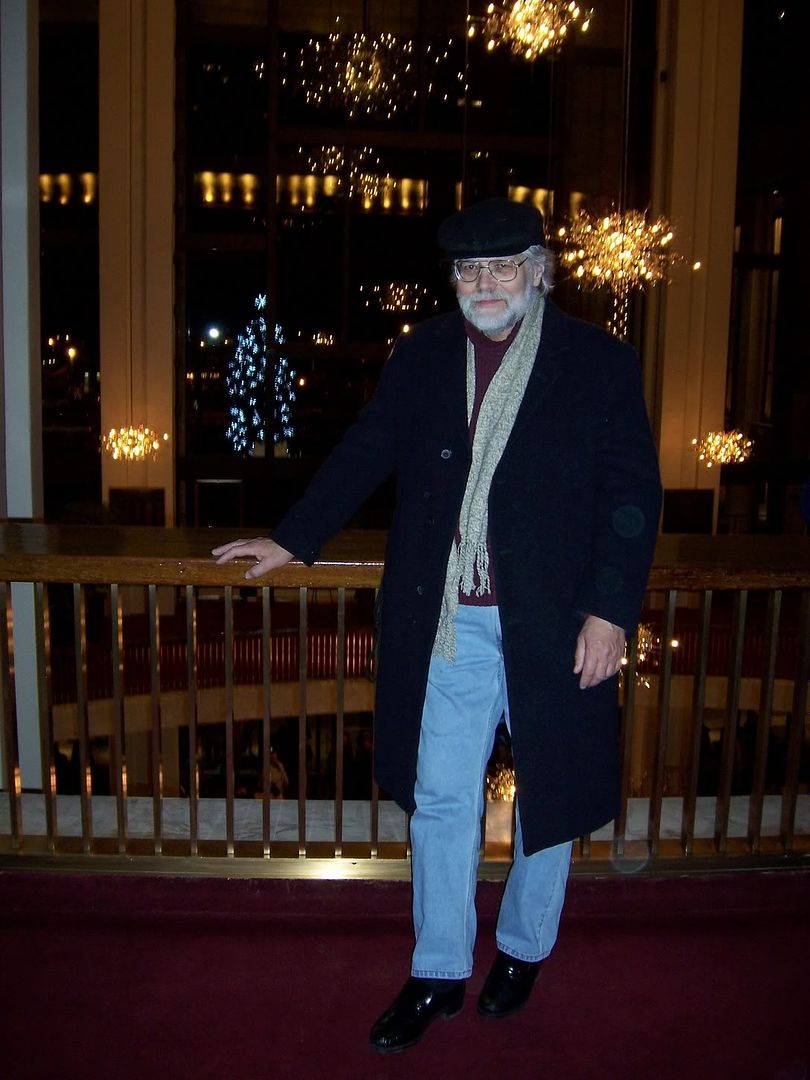
Wednesday, December 14, I went to Carmen at the Metropolitan Opera in New York City, aka The Met—seldom confused in conversation with the other Met, the Metropolitan Museum.
The MTA strike hadn't started yet and the city was alive and aglow with the holiday season festivities. The War in Iraq did not intrude on our consciousness, let alone our activities. The war was not making a difference in the lives of the revelers, as far as I could tell. Whatever disturbance was occurring, was occurring out of sight and out of mind.
Not so with the strike against the Metropolitan Transportation Authority (MTA) by the Transport Workers Union (TWU), now that it has started. "My god," say the Republican politicians, "the strike is disrupting our lives. We're not safe. People can't get to work. The stores are empty. This is an illegal strike. Fine the union. This is happening to us. It has to end. Now!"
If Iraq weren't so tragic, the irony would be laughable.
Some background to the strike: First, I unabashedly support the unions. The last minute change to the pension contribution, the excess funds accumulated by the MTA, and Mayor Bloomberg's willingness to give hundreds of millions of dollars in MTA property value to wealthy associates create a climate of distrust on the part of the workers who do the work that creates the wealth. There is no good-faith bargaining on the part of the MTA if they hide behind the "no-strike" law to bring the workers to heel.
Then like Bush #43 on 9/11, Bloomberg invokes the decrease in crime in the city in his comments about the need for the union to return to work, as if people don't want to work.
What we need is a living wage ... enough to support a family with children.
Tuesday, December 20, 2005
What is it that President Bush doesn’t understand?
In CONGRESS, JULY 4, 1776,
the unanimous Declaration of the thirteen united States of America:
We hold these truths to be self-evident, that all men are created equal, that they are endowed by their Creator with certain unalienable Rights, that among these are Life, Liberty and the pursuit of Happiness.the unanimous Declaration of the thirteen united States of America:
The Constitution for the United States of America
Amendment IV:
The right of the people to be secure in their persons, houses, papers, and effects, against unreasonable searches and seizures, shall not be violated, and no Warrants shall issue, but upon probable cause, supported by Oath or affirmation, and particularly describing the place to be searched, and the persons or things to be seized.The Gettysburg Address:
… government of the people, by the people, for the people shall not perish from the earth.President Bush's order to spy on citizens of these United States of America is a clear violation of his oath of office to uphold the Constitution of the United States, and is in direct opposition to the principles that have made our nation great.
Let's not forget that a big--like in HUGE--reason we were blindsided on 9/11 was the administration's--led by Secretary of Defense Rumsfeld--preoccupation with a Stars Wars defense.
You know, it does get a wee bit scarey when this little ol' farm boy from Northern Minnesota can spot the manure pile from a distance, and those standing in the middle of it, can't even detect the odor.
Friday, December 16, 2005
How quickly times flies ...
How quickly time flies when you're old and having fun.
The war in Iraq has a kind of surreal experience for those of us in the United States who are making no real sacrifice in waging it. Yet our President calls on us to persevere, to stay the course until victory is achieved.
Does that mean "continue shopping as usual"?
Whatever ... Bush #43 has a strange way of rallying the nation to the barricades. His call to arms seems to be, "Stay where you are and trust me. Unless, of course, you qualify for enlistment in the Armed Services. Then it's "Come on down, the price is right (cuz you're poor and we'll pay you to fight)".
Then over in Iraq itself, when I learn more about the constitution now in effect, I simply shake my head in bewilderment. Are our leaders delusional?
The following words end the lead editorial, "Iraq's Most Important Election", in the NY Times for Wednesday, December 13:
"A more diverse representation of Shiite political views and a smaller role for the sinister party militias, which are now an important element of the Iraqi Army and police forces, would be welcome developments. That could also make Sunni Arab neighborhoods feel less threatened. Democracy entitles the majority to rule, but not at the expense of everyone else."
Let me repeat that, "Democracy entitles the majority to rule, but not at the expense of everyone else."
Are they kidding us? What kind of sophomoric pabulum are "these people" (are they neocon Zionists in liberal smocks?) trying to feed us?
You don't even have to be a majority in the US ... just have the majority of the votes counted, and the opposition is in trouble. And we are supposedly a "mature" democracy! Think DeLay in Texas ... and the Democrats before the Republicans.
Who is dealing with the reality on the ground over there?
If these are our "intelligentsia" on the "liberal" side ... we are in such deep doo-doo that we might as well start learning Chinese.
Somehow the neocons have forgotten that it is the separation and resulting balance of real political power basically outside our military that makes our nation so strong democratically. It is the VERY real sense that the tables can and do turn in one's own lifetime that keeps the semblance of fairness in government we have. Whenever one power center starts believing it has a lock on political power, corruption spreads faster than an oil slick on a pool of water.
In a patriarchal society people do not give up power and control without a fight. (It may be the same in all societies.) In a democracy we decree that the battle is in the ballot. And what happens then? Look at Florida in 2000. Look at Ohio in 2004. Think "easily manipulated electronic voting machines" ... and we are supposedly a mature democracy, for chrissake.
As long as reason is pulled along by testosterone ... and the males engage in pissing contests ... pissing into the wind always has a predictable outcome.
The war in Iraq has a kind of surreal experience for those of us in the United States who are making no real sacrifice in waging it. Yet our President calls on us to persevere, to stay the course until victory is achieved.
Does that mean "continue shopping as usual"?
Whatever ... Bush #43 has a strange way of rallying the nation to the barricades. His call to arms seems to be, "Stay where you are and trust me. Unless, of course, you qualify for enlistment in the Armed Services. Then it's "Come on down, the price is right (cuz you're poor and we'll pay you to fight)".
Then over in Iraq itself, when I learn more about the constitution now in effect, I simply shake my head in bewilderment. Are our leaders delusional?
The following words end the lead editorial, "Iraq's Most Important Election", in the NY Times for Wednesday, December 13:
"A more diverse representation of Shiite political views and a smaller role for the sinister party militias, which are now an important element of the Iraqi Army and police forces, would be welcome developments. That could also make Sunni Arab neighborhoods feel less threatened. Democracy entitles the majority to rule, but not at the expense of everyone else."
Let me repeat that, "Democracy entitles the majority to rule, but not at the expense of everyone else."
Are they kidding us? What kind of sophomoric pabulum are "these people" (are they neocon Zionists in liberal smocks?) trying to feed us?
You don't even have to be a majority in the US ... just have the majority of the votes counted, and the opposition is in trouble. And we are supposedly a "mature" democracy! Think DeLay in Texas ... and the Democrats before the Republicans.
Who is dealing with the reality on the ground over there?
If these are our "intelligentsia" on the "liberal" side ... we are in such deep doo-doo that we might as well start learning Chinese.
Somehow the neocons have forgotten that it is the separation and resulting balance of real political power basically outside our military that makes our nation so strong democratically. It is the VERY real sense that the tables can and do turn in one's own lifetime that keeps the semblance of fairness in government we have. Whenever one power center starts believing it has a lock on political power, corruption spreads faster than an oil slick on a pool of water.
In a patriarchal society people do not give up power and control without a fight. (It may be the same in all societies.) In a democracy we decree that the battle is in the ballot. And what happens then? Look at Florida in 2000. Look at Ohio in 2004. Think "easily manipulated electronic voting machines" ... and we are supposedly a mature democracy, for chrissake.
As long as reason is pulled along by testosterone ... and the males engage in pissing contests ... pissing into the wind always has a predictable outcome.
Wednesday, October 19, 2005
Cheney Neocons vs the CIA Nincompoops
Underneath the CIA leak story is a monumental battle
of the titans: Cheney Neocons vs the CIA Nincompoops
(aka the underdogs). Quarterbacking the Neocons is
Cheney, a stalwart Neocon Armageddonist with strategic
alliances with powerful people. For the
Nincompoops--now staging a fourth quarter comeback
from what was thought to be certain defeat--is Bush
#41, a global CIA'er and marshalling a roster of what
was thought to have been has-beens.

The personal stuff comes from Cheney and the Neocons
manipulating the kid (aka Bush #43) into doing their
bidding ... and then really, really screwing things up
with the Rumsfled Doctrine: "Stuff happens" ... rather
than following the Colin line: "If you break it, you
own it."

Well, Pappy Bush (#41) ain't gonna take it lying down
... I wouldn't be a bit surprised that he and his
squad are active in the dethroning of Cheney (like in,
"How could Cheney do this to our boy?", asked Babs.
"You go get him, hear. Wring his neck for me.")

This is Greek drama at its best ... the hubris of the
high and mighty ... the titans battling for turf ...
the honor of the annointed scion at stake ...

God, this is the Hatfields and McCoys ... an American
feud ... reality ... live.

Is this gonna make a fantastic Oliver Stone movie or
what?!

(Cheers)

(Fade to black)

(Roll credits)
Saturday, October 15, 2005
Harriet Miers? Why Harriet Miers?
Harriet Miers? Why Harriet Miers?
Maybe it's all part of the unraveling of the Plame-gate aka Scooter-gate conspiracy to sell the Iraqi War.
Bush wants someone on the Supreme Court who actually knows what went on in the White House and that he, Bush, really was in a bubble, and really, really did believe the stuff fed to him by the Cheney-Neocon cabal about WMD in Iraq during the lead-up to the war.
It would all go back to Neocon’s recognizing early on that the Bush-Rove dynamic duo was the perfect political engine to pull the Neocon vehicle to the pinnacle of power.
Rove would do anything to get Bush elected, and Bush would simply accept it as his due … from God, no less. There would be no introspective soul-searching. Bush knew he was chosen by God. Rove was focused on getting Bush elected to the presidency ... twice.
There was nothing strange in this to tip Bush off, to tweak his curiosity, to set off an alarm. This was the way life always turned out for him. Success happened to him personally … no matter what.
Well, Rove has it figured it out. He and Bush have been had by Scooter and Cheney. And Scooter’s involving him, Rove, in the outing of Valerie Plame is now--with Fitzgerald untangling the threads, connecting the dots--threatening to pull the rug out from under the whole shebang.
Having figured out that he was purposely made the fall guy to protect Scooter and Cheney’s butts … or at least to make sure the White House stayed on message … or simply because they were too arrogant to think it through … Rove is now coming clean to the grand jury.
But he has the problem that he didn’t come clean at first.
However, his “indiscretion” in pointing out Valerie Plame to Mathew Cooper by mentioning the wife of Joseph Wilson is small potatoes compared to the conspiracy to lie us into war using Bush #43 earnest cheerleading talents.
Rove, of course, has explained all this to Bush.
Voilà! Bush nominates Harriet Miers to the Supreme Court as a backup plan for pulling his chestnuts out of the Neocon fire.
Make any sense? I think it does.
Maybe it's all part of the unraveling of the Plame-gate aka Scooter-gate conspiracy to sell the Iraqi War.
Bush wants someone on the Supreme Court who actually knows what went on in the White House and that he, Bush, really was in a bubble, and really, really did believe the stuff fed to him by the Cheney-Neocon cabal about WMD in Iraq during the lead-up to the war.
It would all go back to Neocon’s recognizing early on that the Bush-Rove dynamic duo was the perfect political engine to pull the Neocon vehicle to the pinnacle of power.
Rove would do anything to get Bush elected, and Bush would simply accept it as his due … from God, no less. There would be no introspective soul-searching. Bush knew he was chosen by God. Rove was focused on getting Bush elected to the presidency ... twice.
There was nothing strange in this to tip Bush off, to tweak his curiosity, to set off an alarm. This was the way life always turned out for him. Success happened to him personally … no matter what.
Well, Rove has it figured it out. He and Bush have been had by Scooter and Cheney. And Scooter’s involving him, Rove, in the outing of Valerie Plame is now--with Fitzgerald untangling the threads, connecting the dots--threatening to pull the rug out from under the whole shebang.
Having figured out that he was purposely made the fall guy to protect Scooter and Cheney’s butts … or at least to make sure the White House stayed on message … or simply because they were too arrogant to think it through … Rove is now coming clean to the grand jury.
But he has the problem that he didn’t come clean at first.
However, his “indiscretion” in pointing out Valerie Plame to Mathew Cooper by mentioning the wife of Joseph Wilson is small potatoes compared to the conspiracy to lie us into war using Bush #43 earnest cheerleading talents.
Rove, of course, has explained all this to Bush.
Voilà! Bush nominates Harriet Miers to the Supreme Court as a backup plan for pulling his chestnuts out of the Neocon fire.
Make any sense? I think it does.
Thursday, October 13, 2005
There is no undoing of it
Thoughts on our War in Iraq:
It is hard to believe
this is happening
at the behest of my country.
Like the good Germans
who swept the ashes
from their window sills
that had fallen overnight
from the crematoriums
We go about our lives
as if it isn't happening.
To our eternal shame.
It has been done.
It is being done.
It will be done.
There is no undoing of it.
Ever.
It is hard to believe
this is happening
at the behest of my country.
Like the good Germans
who swept the ashes
from their window sills
that had fallen overnight
from the crematoriums
We go about our lives
as if it isn't happening.
To our eternal shame.
It has been done.
It is being done.
It will be done.
There is no undoing of it.
Ever.
In the face of fear, have we lost our reason?
The Neocons following the precepts of Leo Strauss were and are into using the power they have to gain more power. It is their willingness to use power to pursue personal authority and the control of ever growing power that is so frightening.
They are steadily and methodically working their way up to a rationale of rattling our nuclear arsenal to establish imperial dominance. Even the strategy of limits on the use of force in Iraq at the current time fits their overall plan. If the people of Iraq accept our cultural dominence voluntarily, so be it. If not, continue the march to Armageddon.
It is to our everlasting shame as a people that we got sucked into this war and continue wreaking this much death and destruction on another people, without being willing to make any sacrifice other than that of our volunteer military whom we have never properly supported in numbers or resources or anything that would remotely signal our understanding of the price others are paying in our name ... win or lose. We are going about our lives as if nothing is happening in Iraq.
We get excited when tsunamis, hurricanes, and earthquakes devastate areas where people live ... and we respond proportionately, or at least try to do so. Why don't we pay closer attention when a war we are waging devastates an area where people live ... for now coming up on three years?
The rhetoric and policies of the Neocons are clearly imperialistic ... for example, the space shield is a non-starter as a shield, but an immense potential success as a weapons system. Another example is the now repeated call to militarize relief efforts.
At the first warning of terrorism, we hurriedly comply with the commands of the authorities. And again ... and again ... and again ... like white mice in the laboratory. How much of a shock will we withstand to get the cheese?
Is it really true that in the face of fear we have lost our reason?
They are steadily and methodically working their way up to a rationale of rattling our nuclear arsenal to establish imperial dominance. Even the strategy of limits on the use of force in Iraq at the current time fits their overall plan. If the people of Iraq accept our cultural dominence voluntarily, so be it. If not, continue the march to Armageddon.
It is to our everlasting shame as a people that we got sucked into this war and continue wreaking this much death and destruction on another people, without being willing to make any sacrifice other than that of our volunteer military whom we have never properly supported in numbers or resources or anything that would remotely signal our understanding of the price others are paying in our name ... win or lose. We are going about our lives as if nothing is happening in Iraq.
We get excited when tsunamis, hurricanes, and earthquakes devastate areas where people live ... and we respond proportionately, or at least try to do so. Why don't we pay closer attention when a war we are waging devastates an area where people live ... for now coming up on three years?
The rhetoric and policies of the Neocons are clearly imperialistic ... for example, the space shield is a non-starter as a shield, but an immense potential success as a weapons system. Another example is the now repeated call to militarize relief efforts.
At the first warning of terrorism, we hurriedly comply with the commands of the authorities. And again ... and again ... and again ... like white mice in the laboratory. How much of a shock will we withstand to get the cheese?
Is it really true that in the face of fear we have lost our reason?
Friday, September 30, 2005
Madama Butterfly
There are times in my life when I fully understand the joy of living. Last night was one.
I went with a friend to the New York City Opera's performance of Madama Butterfly at the New York State Theater in Lincoln Center on Manhattan.
Shu Ying Li, making her house debut in the title role of Madama Butterfly, was given ovations during the performance and then met with a standing ovation for her bows at the end.
Robert Mack as Goro, Jake Gardner as Sharpless, and Kathryn Friest as Suzuki were superb among an excellent cast.
New York City is beyond one person's encompassing. It's boundaries of experience are beyond any horizon I can imagine, let alone see. It's diversity in all things human is incredibly unplumbable ... unfathomable.
Yet like swimming in the ocean ... all drops of water are connected, and the ripples from my strokes are radiated outward throughout ... even as the ripples of others reach me, no matter the conscious awareness of any given one.
Then there are the times like last night, when the surge of energy is a tidal wave of emotion—of human response—sweeping over me.
And in experiencing being part of this ... knowing that I bring an essential part to the huge wave ... being part of it ... in the close personal involvement with a friend and in the anonymity of the crowd, the audience ... I experience an unbounded joy of human existence.
I went with a friend to the New York City Opera's performance of Madama Butterfly at the New York State Theater in Lincoln Center on Manhattan.
Shu Ying Li, making her house debut in the title role of Madama Butterfly, was given ovations during the performance and then met with a standing ovation for her bows at the end.
Robert Mack as Goro, Jake Gardner as Sharpless, and Kathryn Friest as Suzuki were superb among an excellent cast.
New York City is beyond one person's encompassing. It's boundaries of experience are beyond any horizon I can imagine, let alone see. It's diversity in all things human is incredibly unplumbable ... unfathomable.
Yet like swimming in the ocean ... all drops of water are connected, and the ripples from my strokes are radiated outward throughout ... even as the ripples of others reach me, no matter the conscious awareness of any given one.
Then there are the times like last night, when the surge of energy is a tidal wave of emotion—of human response—sweeping over me.
And in experiencing being part of this ... knowing that I bring an essential part to the huge wave ... being part of it ... in the close personal involvement with a friend and in the anonymity of the crowd, the audience ... I experience an unbounded joy of human existence.
Tuesday, September 27, 2005
I am an existentialist, Part IV
I experience my own existence. What I experience is my own existence.
I have no idea whether or not what I experience “is real”. I experience it “as real”.
What this means is that I have no way of proving conclusively that there is any other conscious awareness of existence other than my own, but I experience my existence as though I am not unique in experiencing existence.
I choose to believe that I am not the only conscious awareness of existence in the cosmos. I choose to believe that I can communicate with other “conscious awareness-es”, primarily human ones that share my form of communication. I choose to believe that I may influence those with whom I communicate, as they influence me.
I state “ I choose to believe” because these are all propositions that I have consciously considered and I have consciously decided to believe.
Which raises the question, are there beliefs I hold that I did not choose to believe in? That someone or something else chose for me to believe in and taught to me as "the truth"? And then, what if whether or not I believe in something signals whether or not I belong to a particular group of individuals within which I meet my needs? (Remember Maslow’s hierarchy of needs?)
This starts getting very complicated very quickly.
What I can tell you from personal experience is that the process of rejecting my childhood faith which is the belief structure of my siblings, and much of my extended family, was traumatic. It has only been through the insights gained in the study of the various facets of existentialism that I have been able to replace my childhood faith with a coherent set of beliefs that allows me to maintain anything close to rational consistency throughout all the varied aspects of my life.
In a nutshell this rational consistency is simply understanding that if I maintain a basis (the means) for satisfying my needs that allows me to pursue the uniquely human experience of applying my imagination to "What might be" and selecting from the infinite range of options, "What ought to be," and then trying to make it, "What is",—then I am able to engage in choice at what I choose to believe is the highest form of human existence, being creative in a community committed to love.
(See “I am an existentialist, Part III” for my definition of love in human terms.)
I have no idea whether or not what I experience “is real”. I experience it “as real”.
What this means is that I have no way of proving conclusively that there is any other conscious awareness of existence other than my own, but I experience my existence as though I am not unique in experiencing existence.
No matter how I approach my existence, I cannot avoid the necessity of choice. Not choosing anything in particular is itself a choice. This is the nature of the individual in the cosmos. I am alone in this responsibility. My conscious awareness in my mind is mine alone. I do not share my personal conscious awareness with any other living creature. What is more, I existed before I became consciously aware of my existence. Existence comes first. I believe it comes first at all levels of life. –from “I am an existentialist”
I choose to believe that I am not the only conscious awareness of existence in the cosmos. I choose to believe that I can communicate with other “conscious awareness-es”, primarily human ones that share my form of communication. I choose to believe that I may influence those with whom I communicate, as they influence me.
I state “ I choose to believe” because these are all propositions that I have consciously considered and I have consciously decided to believe.
Which raises the question, are there beliefs I hold that I did not choose to believe in? That someone or something else chose for me to believe in and taught to me as "the truth"? And then, what if whether or not I believe in something signals whether or not I belong to a particular group of individuals within which I meet my needs? (Remember Maslow’s hierarchy of needs?)
This starts getting very complicated very quickly.
What I can tell you from personal experience is that the process of rejecting my childhood faith which is the belief structure of my siblings, and much of my extended family, was traumatic. It has only been through the insights gained in the study of the various facets of existentialism that I have been able to replace my childhood faith with a coherent set of beliefs that allows me to maintain anything close to rational consistency throughout all the varied aspects of my life.
In a nutshell this rational consistency is simply understanding that if I maintain a basis (the means) for satisfying my needs that allows me to pursue the uniquely human experience of applying my imagination to "What might be" and selecting from the infinite range of options, "What ought to be," and then trying to make it, "What is",—then I am able to engage in choice at what I choose to believe is the highest form of human existence, being creative in a community committed to love.
(See “I am an existentialist, Part III” for my definition of love in human terms.)
I am an existentialist, Part III
[M]y take on existentialism is that it does not deny the hierarchy of needs but that it understands, as Maslow did, that our resolution of these needs impacts and and is impacted upon by our potential for self-actualization. -from "I am an existentialist, continued"
The choices I make in fulfilling my needs impact my potential for self-actualization. If I take things for myself without sharing, if I treat others as objects for my gratification, if I fail to engage with others as in:
I would add that I believe in nuturing the other person by sharing ... and particularly in sharing the creative experience, the uniquely human experience of applying our imagination to "What might be" and selecting from the infinite range of options, "What ought to be," and then making it, "What is." -from "Am I Christian Existentialist?"
Creating the community where this process thrives for all its members interactively, is what is best for humanity.
It should be understood, that with Maslow’s hierarchy of needs as a conceptual structure, I am declaring that the hierarchy of needs from physiological to safety to love/belonging to esteem leading to actualization have to be met. The struggle is to do this without blocking the individual’s potential for self-actualization.
Finally, choosing (selecting) “What ought to be” is meaningless if I do not also act to try to make it “What is”. Here we have the admonition of James in the New Testament of the Christian Bible, “Faith without works is dead.”
For as the body without the spirit is dead, so faith without works is dead also. -James 2:26
Monday, September 26, 2005
I am an existentialist, continued
Note: I received the following response to my previous post, "I am an esistentialist":
Thank you for reviewing my article.
I feel that I do not have to defend existentialism ... far more erudite individuals than myself have already done so effectively.
But you raise a few points to which I have to take exception lest someone gets the impression that there is no argument to them.
Having a choice for the existentialist is a concrete situation, probably most graphically demonstrated by those who have used self-immolation as a form of protest.
From wikipedia:
Famous people who have chosen this way to die:
* Romas Kalanta, in protest against the Soviet Union's occupation of his homeland of Lithuania.
* Thích Quảng Ðức, in protest against the oppression of Buddhism by the administration of Vietnamese Prime Minister Ngô Đình Diệm.
* Norman Morrison, an American who self-immolated in protest against the Vietnam War
(See http://en.wikipedia.org/wiki/Suicide_methods#Burning_oneself_.28self-immolation.29 )
Granted not everyone has the option of suicide, but that represents a "special case" set of individuals.
And as Mahatma Gandhi taught us, we also have the option of civil disobedience, which can be the simple matter of stopping what we are doing and doing nothing. Cindy Sheehan was arrested today in Washington, DC, for this form of civil disobedience while protesting the War in Iraq.
In the possibility of negation of active participation--either in a specific activity set or in life itself-- existentialism points out that the individual has a choice in the matter of her/his own existence which is not theoretical.
Further, my view of existentialism couples readily with Maslow's hierarchy of needs, agreeing that the best state of individual human existence is at the pinnacle of the hierarchy of needs, self-actualization where I engage in the creative pursuit of fulfilling my imagined "objective" in my own existence.
I have been fortunate to have known no other situation during my entire life of 66+ years than this creative pursuit. And I have never been not able to satisfy my needs.
Of course, as Malow pointed out, if I am struggling to breathe, or to find water to drink, or food to eat, ... and so forth through the hierarchy of needs from physiological to safety to love/belonging to esteem leading to actualization ... I am not going to be otherwise engaged primarily. Self-actualization may have to wait at times. It's just that I have never experienced this other than in a situation where I have known I could satisfy my needs of the moment.
However, even without personal experience of dire unmet need--or quite possibly because of that lack of experience--my take on existentialism is that it does not deny the hierarchy of needs but that it understands, as Maslow did, that our resolution of these needs impacts and is impacted upon by our potential for self-acutalization.
(See http://en.wikipedia.org/wiki/Self-actualization )
Thanks again for reviewing my article.
Best,
Gus
Hilding "Gus" Lindquist
Interesting article. My personal opinion is that "You have a choice" is a generalization. It varies from issue to issue and many times you don't really have a chance. Existentialism is an interesting theory. However unless it allieviates human suffering and helps solving personal problems, some of the features of such theories are intellectual gymnastics. Philosophers also need to be practical.This is my reply:
Thank you for reviewing my article.
I feel that I do not have to defend existentialism ... far more erudite individuals than myself have already done so effectively.
But you raise a few points to which I have to take exception lest someone gets the impression that there is no argument to them.
Having a choice for the existentialist is a concrete situation, probably most graphically demonstrated by those who have used self-immolation as a form of protest.
From wikipedia:
Famous people who have chosen this way to die:
* Romas Kalanta, in protest against the Soviet Union's occupation of his homeland of Lithuania.
* Thích Quảng Ðức, in protest against the oppression of Buddhism by the administration of Vietnamese Prime Minister Ngô Đình Diệm.
* Norman Morrison, an American who self-immolated in protest against the Vietnam War
(See http://en.wikipedia.org/wiki/Suicide_methods#Burning_oneself_.28self-immolation.29 )
Granted not everyone has the option of suicide, but that represents a "special case" set of individuals.
And as Mahatma Gandhi taught us, we also have the option of civil disobedience, which can be the simple matter of stopping what we are doing and doing nothing. Cindy Sheehan was arrested today in Washington, DC, for this form of civil disobedience while protesting the War in Iraq.
In the possibility of negation of active participation--either in a specific activity set or in life itself-- existentialism points out that the individual has a choice in the matter of her/his own existence which is not theoretical.
Further, my view of existentialism couples readily with Maslow's hierarchy of needs, agreeing that the best state of individual human existence is at the pinnacle of the hierarchy of needs, self-actualization where I engage in the creative pursuit of fulfilling my imagined "objective" in my own existence.
I have been fortunate to have known no other situation during my entire life of 66+ years than this creative pursuit. And I have never been not able to satisfy my needs.
Of course, as Malow pointed out, if I am struggling to breathe, or to find water to drink, or food to eat, ... and so forth through the hierarchy of needs from physiological to safety to love/belonging to esteem leading to actualization ... I am not going to be otherwise engaged primarily. Self-actualization may have to wait at times. It's just that I have never experienced this other than in a situation where I have known I could satisfy my needs of the moment.
However, even without personal experience of dire unmet need--or quite possibly because of that lack of experience--my take on existentialism is that it does not deny the hierarchy of needs but that it understands, as Maslow did, that our resolution of these needs impacts and is impacted upon by our potential for self-acutalization.
(See http://en.wikipedia.org/wiki/Self-actualization )
Thanks again for reviewing my article.
Best,
Gus
Hilding "Gus" Lindquist
Sunday, September 25, 2005
I am an existentialist
The essential character of the human being is the experience of our own existence. I believe that, in a very real sense, if I am not consciously aware of my existence, I am not fully human.
With this conscious awareness I can imagine a set of possibilities from which I can choose to pursue one or more. I cannot pursue all of them simultaneously either in the sense of time and resources, or in the sense of being personally able to pursue them even if I had the time and resources. In fact, some possiblilties such as suicide allow for no other possibility for me--ever, in the case of death.
No matter how I approach my existence, I cannot avoid the necessity of choice. Not choosing anything in particular is itself a choice. This is the nature of the individual in the cosmos. I am alone in this responsibility. My conscious awareness in my mind is mine alone. I do not share my personal conscious awareness with any other living creature. What is more, I existed before I became consciously aware of my existence. Existence comes first. I believe it comes first at all levels of life.
After existence comes conscious awareness for the being that is fully human. Following conscious awareness, the next act is always a matter of choosing from whatever set of possibilities exist at the moment for the human being who is consciously aware of her/his own existence.
From the set of possibilities--things that "might be"--I can choose something "to be". When that thing "to be" relates to the way something "is", then I am making a moral decision about what that thing "ought to be". Whether or not I want the thing to stay the same or change, I am making a moral decision. Choosing to have something stay the same is a choice, because we could choose to try to change it.
I alone am responsible for my choices, no matter how much I would like to foist the blame onto someone or something else.
There are a several caveats to this responsibility. One is for when as children we don't know any better. Then we only know what we know, what we have been taught as truth by those we have no reason to distrust.
Another caveat is for mental illness whether chemically induced by drugs or alcohol, or one of the clinically defined syndrones. There are other forms of diminshed capacity, such as mental retardation, all of which can limit an individual's arena of choice.
But this I believe: My ability to imagine possibility and my confidence in my ability to try to bring about some possiblity of my choosing is the core of the creative life ... the highest form of existence of which I am aware. The tension between "isness" and "oughtness", best described by Dr. Martin Luther King, Jr., is the energy imbued in the human condition, the state of being fully human. I can choose what I ought to be, what I ought to do ... and in so doing participate in a creative evolution ... a butterfly flapping its wings, knowing full well the ripples will extend throughout the cosmos.
But no matter what, no matter how I cloak the process in some form of dogma or doctrine--religious, political, philosophical, whatever--I must choose out of my conscious awareness of my existence.
Finally, I am an atheist because as an existentialist, it is immaterial to me whether God exists or not. What is important for me is to be rationally consistent imagining possibility and trying to bring about what I think ought to be. In an earlier post I reflected on the designation of "Christian Existentialist":
With this conscious awareness I can imagine a set of possibilities from which I can choose to pursue one or more. I cannot pursue all of them simultaneously either in the sense of time and resources, or in the sense of being personally able to pursue them even if I had the time and resources. In fact, some possiblilties such as suicide allow for no other possibility for me--ever, in the case of death.
No matter how I approach my existence, I cannot avoid the necessity of choice. Not choosing anything in particular is itself a choice. This is the nature of the individual in the cosmos. I am alone in this responsibility. My conscious awareness in my mind is mine alone. I do not share my personal conscious awareness with any other living creature. What is more, I existed before I became consciously aware of my existence. Existence comes first. I believe it comes first at all levels of life.
After existence comes conscious awareness for the being that is fully human. Following conscious awareness, the next act is always a matter of choosing from whatever set of possibilities exist at the moment for the human being who is consciously aware of her/his own existence.
From the set of possibilities--things that "might be"--I can choose something "to be". When that thing "to be" relates to the way something "is", then I am making a moral decision about what that thing "ought to be". Whether or not I want the thing to stay the same or change, I am making a moral decision. Choosing to have something stay the same is a choice, because we could choose to try to change it.
I alone am responsible for my choices, no matter how much I would like to foist the blame onto someone or something else.
There are a several caveats to this responsibility. One is for when as children we don't know any better. Then we only know what we know, what we have been taught as truth by those we have no reason to distrust.
Another caveat is for mental illness whether chemically induced by drugs or alcohol, or one of the clinically defined syndrones. There are other forms of diminshed capacity, such as mental retardation, all of which can limit an individual's arena of choice.
But this I believe: My ability to imagine possibility and my confidence in my ability to try to bring about some possiblity of my choosing is the core of the creative life ... the highest form of existence of which I am aware. The tension between "isness" and "oughtness", best described by Dr. Martin Luther King, Jr., is the energy imbued in the human condition, the state of being fully human. I can choose what I ought to be, what I ought to do ... and in so doing participate in a creative evolution ... a butterfly flapping its wings, knowing full well the ripples will extend throughout the cosmos.
But no matter what, no matter how I cloak the process in some form of dogma or doctrine--religious, political, philosophical, whatever--I must choose out of my conscious awareness of my existence.
Finally, I am an atheist because as an existentialist, it is immaterial to me whether God exists or not. What is important for me is to be rationally consistent imagining possibility and trying to bring about what I think ought to be. In an earlier post I reflected on the designation of "Christian Existentialist":
Putting it another way, How do we humans become God? What God do I want us to become? The answer FOR ME is in nuturing the potential in the other person ... and this is what I believe Jesus' message to be ... hence am I a Christian Existentialist? Should I use the term "Christian" with today's mixed baggage of meaning? I don't know. I'll think about it.See "Am I a Christian Existentialist?"
I would add that I believe in nuturing the other person by sharing ... and particularly in sharing the creative experience, the uniquely human experience of applying our imagination to "What might be" and selecting from the infinite range of options, "What ought to be," and then making it, "What is."
Thursday, September 22, 2005
Revisiting the military-industrial complex
I would suggest that in pursuing the subject, "Katrina and The Collective Good", (see posting of that title) it is time for us to revisit Dwight D. Eisenhower, Military-Industrial Complex Speech of 1961. The full text can be found at:
The most famous paragraph from Eisenhower's speech is:
Please ponder his words in light of the path ahead for our nation. Where does "stay the course" take us?
Note: If that link is blocked, try:
If THAT link is also blocked, google "military industrial complex" and you will be able to link to one of several sites that offer the full text from President Eisenhower's public papers.
The most famous paragraph from Eisenhower's speech is:
In the councils of government, we must guard against the acquisition of unwarranted influence, whether sought or unsought, by the military[-]industrial complex. The potential for the disastrous rise of misplaced power exists and will persist.Earlier he spoke these words:
Throughout America's adventure in free government, our basic purposes have been to keep the peace; to foster progress in human achievement, and to enhance liberty, dignity and integrity among people and among nations. To strive for less would be unworthy of a free and religious people. Any failure traceable to arrogance, or our lack of comprehension or readiness to sacrifice would inflict upon us grievous hurt both at home and abroad.Let me repeat for emphasis these words of Eisenhower's, "...; balance between actions of the moment and the national welfare of the future. Good judgment seeks balance and progress; lack of it eventually finds imbalance and frustration."
Progress toward these noble goals is persistently threatened by the conflict now engulfing the world. It commands our whole attention, absorbs our very beings. We face a hostile ideology -- global in scope, atheistic in character, ruthless in purpose, and insidious in method. Unhappily the danger is [it] poses promises to be of indefinite duration. To meet it successfully, there is called for, not so much the emotional and transitory sacrifices of crisis, but rather those which enable us to carry forward steadily, surely, and without complaint the burdens of a prolonged and complex struggle -- with liberty the stake. Only thus shall we remain, despite every provocation, on our charted course toward permanent peace and human betterment.
Crises there will continue to be. In meeting them, whether foreign or domestic, great or small, there is a recurring temptation to feel that some spectacular and costly action could become the miraculous solution to all current difficulties. A huge increase in newer elements of our defense; development of unrealistic programs to cure every ill in agriculture; a dramatic expansion in basic and applied research -- these and many other possibilities, each possibly promising in itself, may be suggested as the only way to the road we wish to travel.
But each proposal must be weighed in the light of a broader consideration: the need to maintain balance in and among national programs -- balance between the private and the public economy, balance between cost and hoped for advantage -- balance between the clearly necessary and the comfortably desirable; balance between our essential requirements as a nation and the duties imposed by the nation upon the individual; balance between actions of the moment and the national welfare of the future. Good judgment seeks balance and progress; lack of it eventually finds imbalance and frustration.
The record of many decades stands as proof that our people and their government have, in the main, understood these truths and have responded to them well, in the face of stress and threat. But threats, new in kind or degree, constantly arise. I mention two only.
Please ponder his words in light of the path ahead for our nation. Where does "stay the course" take us?
Saturday, September 17, 2005
Folks, this is fascism
"'I don't think federal bureaucracy can handle the next disaster," said Toye Taylor, the president of Washington Parish, one of the hardest hit areas in Louisiana, who met with Mr. Bush this week.
"I expressed to the president that it would take a new partnership between the military and private sector," Mr. Taylor said. 'Because there will be another one and I don't think the federal government is going to be able to help." Indeed, Mr. Bush said in his address to the nation from New Orleans on Thursday night that the military would play a new role in federal disaster relief."
"FEMA, Slow to the Rescue, Now Stumbles in Aid Effort"
By JENNIFER STEINHAUER and ERIC LIPTON
NY Times, September 17, 2005
Link to article
By JENNIFER STEINHAUER and ERIC LIPTON
NY Times, September 17, 2005
Link to article
From wikipedia: The Doctrine of Fascism
The Labour Charter (Promulgated by the Grand Council for Fascism on April 21, 1927)—(published in the Gazzetta Ufficiale, April 3, 1927) [sic] (p. 133)
The Corporate State and its Organization (p. 133)
The corporate State considers that private enterprise in the sphere of production is the most effective and usefu [sic] [typo-should be: useful] instrument in the interest of the nation. In view of the fact that private organisation of production is a function of national concern, the organiser of the enterprise is responsible to the State for the direction given to production.
State intervention in economic production arises only when private initiative is lacking or insufficient, or when the political interests of the State are involved. This intervention may take the form of control, assistance or direct management. (pp. 135-136)
Benito Mussolini, 1935
Fascism: Doctrine and Institutions
Rome: 'Ardita' Publishers
What the hell is going on?!
The Patriot Act, which limits the freedoms of patriots ... provocative by its very nature and thereby self-fulfilling in its proof of the need for further restrictions on freedom.
A strategy in Iraq destined to provoke an insurgency that can only be quelled by the Battle of Armageddon ... which we will win because we have the bomb, right?
And now after the purposeful gutting of the working govenment, we have the calls for the militarization of our nation.
What's going on? This is FASCISM, folks.
Fascism: Doctrine and Institutions
Rome: 'Ardita' Publishers
What the hell is going on?!
The Patriot Act, which limits the freedoms of patriots ... provocative by its very nature and thereby self-fulfilling in its proof of the need for further restrictions on freedom.
A strategy in Iraq destined to provoke an insurgency that can only be quelled by the Battle of Armageddon ... which we will win because we have the bomb, right?
And now after the purposeful gutting of the working govenment, we have the calls for the militarization of our nation.
What's going on? This is FASCISM, folks.
Thursday, September 15, 2005
Katrina and the collective good
A work in progress: 9/25 9:45AM update
Note: 9/25 edits below.
Note: 9/25 edits below.
Note: Defining "the collective good" broadly, wikipedia—the free online encyclopedia—gives us the following: "the term 'collective good' describes all that is good for all people in a given community". (See collective good, community at http://en.wikipedia.org/wiki/Main_Page)
Let's begin by thinking for a moment about our community. How do we define it? Who belongs to it?
OK, with some "idea" of "our" community, no matter how clearly defined or ill-defined, formed or forming in our minds, let us think for a moment about three things:
1. What do we expect to be able to receive from our community?
2. What do we expect to have to give to our community?
3. To what extent do we believe we have these expectations in common with the other members of our community?
OK, we're getting somewhere. Now, in focusing on "the collective good" let us limit our expectations in 1 and 2 to only those expectations that we believe everyone in our community has a rational reason to believe that they apply to everyone. In other words, using 3 as a filter, let's rethink 1 and 2.
For example, I believe that some basic level of police and fire protection, and emergency medical care, should be available to everyone in my community. I also believe that everyone in my community should help pay for it. Yes—as they say—the devil is in the details. But I think you get the idea of the approach I am using to consider—revisit in my mind, and yours—the concept of "the collective good" in light of Katrina.
Another expectation I have that I consider part of the collective good of whatever community in which I am a member is that my community will defend my safety and security from our enemies. In this I expect my community to maintain as strong a defense system as necessary to keep the community safe and secure in the world as we understand it to be. In this regard, I support having a military as well as other support systems strong enough to provide that safety and security for my community.
I think you can see where this—the consideration of the collective good in light of Katrina—is leading in part.
As the gestalt continues to take shape in our minds, let us return to considering the question of who belongs to "our" community. Here is where--I believe--the issues of race, class, ethnic and cultural heritage, religious persuasion, and other identity factors play a large part in our sense of committment to others who may be within the geographical and political boundaries of our legally defined community, but who are not those with whom we share a la 3 the expectations of 1 and 2.
What about community? On one hand we have Hobbes dictum found in the following depiction of his thought:
Self-defense against violent death is Hobbes' highest human necessity, and rights are borne of necessity. In the state of nature, then, each of us has a right to everything in the world. Due to the scarcity of things in the world, there is a constant, and rights-based, "war of all against all" (bellum omnium contra omnes). Life in the state of nature is "solitary, poore, nasty, brutish, and short"
Source: wikipedia
On the other hand we have the infantry platoon where individual soldiers often give their lives to defend the platoon or even another comrade. Under this banner of camaraderie we also find parents, firefighters, police officers, and a host of others sacrificing self for the good of the others either as specific individuals in need of rescue or entire communities.
Less dramatic than the willingness to risk one's life, is the willingness to share one's "treasure" ... and in the aftermath of Katrina we see the outpouring of this willingness to share our resources even with people we have never met ... and in the case of the recent tsunami, those who aren't fellow citizens either.
How then does this sense of committment to community take hold in the individual? Or maybe the question should be, how is it lost?
Prior to Katrina, we weren't rallying to do something about the poverty in New Orleans.
Was the difference that we saw the hurricane as something that could happen to us? The disaster created a common bond where before there was none because we had an "us" versus "them" view of poor black people? That somehow "they" HAD to be different then us, or why would they be poor? For some of us the determining factor (the ONLY determining factor) is the indvidual's relationship with God THE FATHER, who blesses us according to HIS wisdom and grace.
From my experience, what seems to emerge as the determining factor in how we relate to one another is whether or not we have something in common that unites as members of a definable group, allowing one to think of the other as "friend" rather than "foe".
For the time being let us define "friend" as someone we would share something with, and "foe" as someone we would withhold something from.
Yes, a "friend" for sharing a ride to work, could be a "foe" when asked to loan him or her money. this can get complicated.
Again from my experience, there comes to mind the religious divide of believer and unbeliever as the fundamental and unbridgeable division that separates us, one from the other. To the True Believer our common humanity is not enough ... except in the instance of the parable of the Good Samaritan, where we are united in the need for caring by one from the other, which then becomes evidence of the caregiver's faith in God and not necessarily his or her faith in humanity of the needy other. This seems particularly true when we are not willing to act to mitigate the circumstances that lead to the dire straits of the needy other, but only act to ameliorate the consequences of our earlier failure.
The other divisions determining "us" versus "them" I sugested above—of race, class, ethnic and cultural heritage, and so forth—come into play as barriers to developing a common sense of community.
There is also the factor of not being strangers to one another in the concrete sense of actually knowing the other person as someone we recognize or do not recognize. Then we can take a defined "person type" such as a person in a police uniform, or a teacher at the head of a classroom, or a minister or priest wearing a clerical collar, and so forth, all having more or less "friendly" images. On the other hand we have the "enemy" images ... and just describing them gives us a sense of difficulties we will face in attempting to build common ground in our diverse world.
Paul Krugman writes in his column, " Tragedy in Black and White" on the New York Times, Monday, September 19, Op/Ed page:
And who can honestly deny that race is a major reason America treats its poor more harshly than any other advanced country? To put it crudely: a middle-class European, thinking about the poor, says to himself, "There but for the grace of God go I." A middle-class American is all too likely to think, perhaps without admitting it to himself, "Why should I be taxed to support those people?"
Above all, race-based hostility to the idea of helping the poor created an environment in which a political movement hostile to government aid in general could flourish.
Please read Dwight D. Eisenhower's speech titled, "Military-Industrial Complex Speech", given in 1961. I refer to it in my posting, Revisiting the military-industrial complex.
Please read Robert G. Kaiser's Op/Ed column titled, "In Finland's Footsteps", from the August 7, 2005, Sunday Outlook section of the Washinton Post.
More to come ...
Below are notes that I am referring to as I write this essay
Title: Defining the Collective Good
- What do we believe is "appropriate help" that we should expect from the larger community to which we belong, and under what circumstances are we entitled to this help?
- How do we participate in receiving this "appropriate help"?
- What do we believe is "appropriate help" to give others in the larger community to which we belong, and under what circumstances are they entitled to this help?
- How do we participate in giving this "appropriate help"?
- How do we define the "larger community" to which we belong?
Sunday, September 11, 2005
The Greenwich Brewing Company
ww.greenwichbrew.com
Location map
Located on the southeast corner of 6th Avenue and 9th Street, and across 9th from Path's 9th Street Station, in Greenwich Village, the Greenwich Brewing Co. has been a favorite restaurant and bar since I first came to the New York City metropolitan area in 1999. Since then I have been coming here alone and with friends as frequently as the opportunity presents itself.
The Greenwich Brewing Co. is my preferred stop for an early dinner when I go to the West Village Conversation Group on Tuesday evenings at the Caffe Dell Arista, a couple of blocks to the northwest, up Greenwich Avenue.
When I am alone, I come here, eat and then spend a few minutes writing in my journal, capturing my mood and thoughts while immersed in the ambience of the Village.
I love it beyond words.
FYI, I usually have the Primavera Pizza with spinach, zucchini, mushrooms and broccoli.
Note: If you click on the thumbnails below, you can view a larger version of the photo.
Greenwich Brewing Co. from across 6th Avenue.
Greenwich Brewing Co. from across 9th Street.
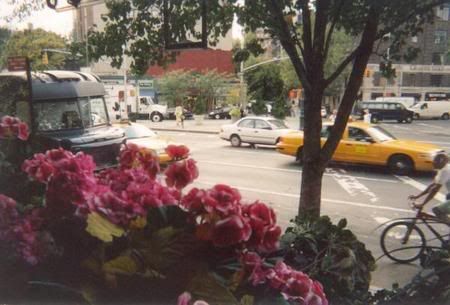
The view from my favorite table,
just inside the front door.
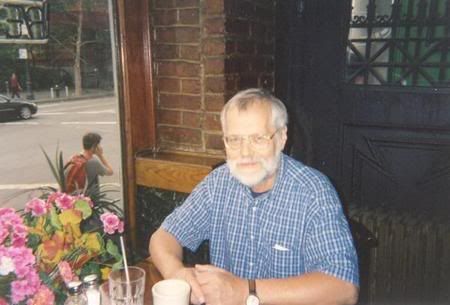
Myself sitting at my favorite table,
summer of '05
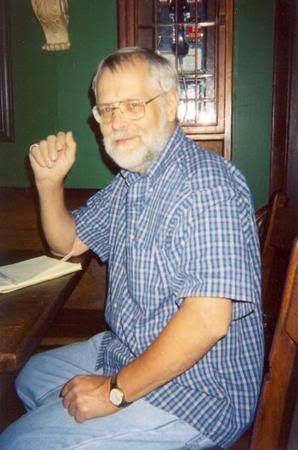
Another view of myself with
my stenographer's notebook journal.
Cheers!
Monday, September 05, 2005
The Caffe Dell Artista
Caffe Dell Artista
Location Map
between 6th and 7th Avenues
Sunday, September 4, in the early evening I sat at the small table anchoring the west end of the large front windows of the Caffe Dell Artista overlooking Greenwich Avenue drinking coffee, eating strawberry cheesecake, and writing in my journal.
Sitting here on the second level of the building above a shop that is partly below street level has an aloof intimacy with the avenue and sidewalk that is enticingly engaging for the philosopher-poet (or is it poet-philosopher?) in me.
With bookends in place for my basic trip to Manhattan ... the Belly Delly on the top of Times Square where once Nick's Deli held sway, and the Caffe Dell Artista in Greenwich Village ... I have the underpinnings for variations on the main theme, the theme of being absorbed in the ultimate center of the urban universe.
Just do not think for a moment that I want you to come with me. I am a soloist.
I have tried to share my journeys with others. Shared, they are not the same. And in all but a limited set of exceptions when the company of another is equal to being alone, I prefer being alone.
I don't know why this is. It is.
I have tried to change ... but, alas, I have failed in doing so. Mostly, I suspect, because I feel no need to change ... nor desire.
In fact at the moment I was sitting at the table in the Caffe Dell Artista writing these notes in my journal in long hand among strangers at other tables, absorbing the energy of their presence ... their laughter and noise ... without having to respond, was rich in the awareness of others as I played by myself in the limitless arena of my mind ... thinking and writing ... the sensuous stroke of the pen on paper ... the cursive flow of my penmanship tactilely stimulating ... engaged in way that I can never be when typing on my computer, alone in my home's office.
Part of this feeling is also caught up in my brain overrunning my hand ... and while my mind loops into its own space, coming back to earth to finish the word, the sentence, the paragraph ... I am connecting galaxies of thought and memory in a way that has no equal for me.
Beyond all this is subliminal transcendental awareness of the history of Greenwich Village ... and my connectedness to the human spirit of this place. I love it so.
Note: If you click on the thumbnails below, you can view a larger version of the photo.
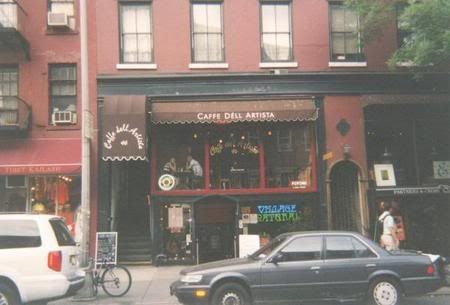
Caffe Dell Artista from across Greenwich Avenue.
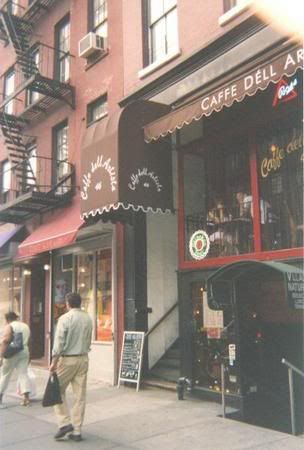
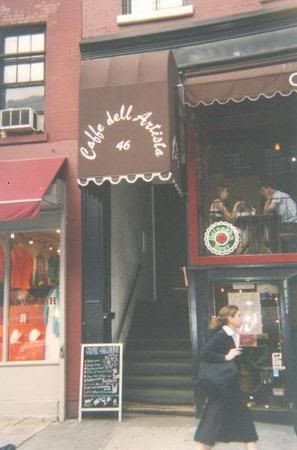
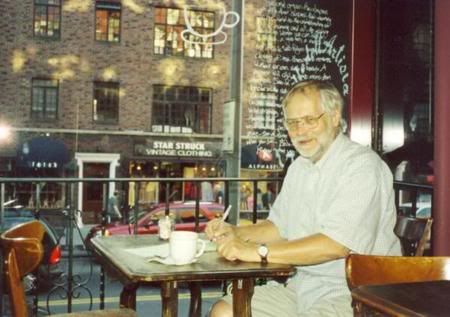
Myself with my stenographer's notebook journal.
Sunday, September 04, 2005
Next stop: easyInternetCafe
easyInternetCafe
234 West 42nd Street
New York, New York
I left the Belly Delly above West 49th Street around 3:30PM Sunday, September 4th, and headed south on 7th Avenue, crossing back and forth between 7th and Broadway as I wandered down to West 42nd Street and the easyInternetCafe where I went in and again logged onto the internet and into my blog.
It is Labor Day weekend and Times Square is teeming with tourists. The weather is gorgeous, sunny and not too hot with a bit of a breeze cooling the sidewalk crowds full of beautiful people interspersed among the rest of us ... in the incredible stew pot of diversity that is Manhattan ... nobody blending in until the residents start wearing black later in the season. The rich multi-color, multi-texture tapistry of people in New York on the warm days of summer.
Just thinking about making the trip to Manhattan raises my energy level several notches. Now I am here and thoroughly enjoying the moment ... expanded across an afternoon ... feeling the energy of the others crowding past absorbed in each others' energy ... knowing I am part of something that transcends each one of us ... knowing that if I stayed in the maw of this human maelstrom I would eventually burn out (maybe not so eventually in my case) ... but also understanding that it will not go away, it will be here whenever I come back.
I'm going to continue on down to Greenwich Village, where I will stop and have an Americano at the cafe where we have the West Village Conversation Group Meets on Tuesday evenings.
Caffe Dell Artista
46 Greenwich Avenue
between 6th and 7th Avenues
New York, NY
Then I'm catching the Path to Hoboken from the 9th Street station and going home.
Note: If you click on the thumbnails below, you can view a larger version of the photo.
Looking west on West 42nd Street
from the 7th Avenue end of the block.

Farther along West 42nd Street
toward the easyInternetCafe.

easyInternetCafe from across West 42nd Street.
Cheers! I'll get back to you.
Nick's Deli is closed
I made the trip from Maplewood, New Jersey, to Nick's Deli on the corner of 7th Avenue and West 49th Street in Times Square via train and subway. When I got there it was closed ... apparently for good.
I hadn't been there for a couple of months, thinking each week that I would make the trip and then putting it off ... mostly I think because it was (is) summer ... and Nick's has always been best done in the cooler months. Now I regret the delay in going.
But all was (is) not lost!
I immediately set out to find another eatery on this end of Times Square. I checked out the Playwright Tavern across 7th and still on West 49th ... a wee bit too uptown for my tastes. I have to have something quite a bit more scruffy ... not in the sense of unkempt, but in the sense of showing signs of plebian wear and tear, a place for us common folk to sit and eat ... and for me, to think and write.
I think I've found it.
BellyDelly Deli
1625 Broadway
Between 49th & 50th St
New York, New York 10019
Tel: 212-333-5650, 5733, 5750
Fax: 212-333-7464
And guess what, not only do they make an excellent tuna salad sandwich and have good drip coffee, they have a real salad bar AND internet access both via wifi and computer kiosks. (In fact, I am posting this message from one of their NEXTNET public internet access terminals. I purchased a prepaid card at the downstairs register and got on.)
My imagination is running sort of wild at the moment ... having a deli as THE end terminus of this particular journey where I come to the north end of Times Square on the N or R Trains, have my standard fare of a tuna salad sand with a pickle on the side and coffee, sit and comntemplate my navel while making some entries in my journal ... then wander on foot back down through Times Square before either returning directly home via the Midtown Direct commuter train from Penn Station or continuing further south to Greenwich Village and catching the Path from the 9th Street station to Hoboken and then taking NJ Transit to Maplewood ... has always been a the big attraction of the trip. And now to also have internet access in the deli ... well, can we get any closer to heaven on earth?
Plus, this gives me some incentive to clean up my www.aheadinnyc.com website ...
One negative, they were out of pickles.
Note: If you click on the thumbnails below, you can view a larger version of the photo.

Nick's Gourmet Deli before it closed.

Nick's Gourmet Deli after it closed,
from across 7th Avenue.

Nick's Gourmet Deli after it closed,
from across West 49th Street.

The BellyDelly Deli
looking up Broadway

The BellyDelly Deli
looking down Broadway.

The BellyDelly Deli.
Cheers!
I hadn't been there for a couple of months, thinking each week that I would make the trip and then putting it off ... mostly I think because it was (is) summer ... and Nick's has always been best done in the cooler months. Now I regret the delay in going.
But all was (is) not lost!
I immediately set out to find another eatery on this end of Times Square. I checked out the Playwright Tavern across 7th and still on West 49th ... a wee bit too uptown for my tastes. I have to have something quite a bit more scruffy ... not in the sense of unkempt, but in the sense of showing signs of plebian wear and tear, a place for us common folk to sit and eat ... and for me, to think and write.
I think I've found it.
BellyDelly Deli
1625 Broadway
Between 49th & 50th St
New York, New York 10019
Tel: 212-333-5650, 5733, 5750
Fax: 212-333-7464
And guess what, not only do they make an excellent tuna salad sandwich and have good drip coffee, they have a real salad bar AND internet access both via wifi and computer kiosks. (In fact, I am posting this message from one of their NEXTNET public internet access terminals. I purchased a prepaid card at the downstairs register and got on.)
My imagination is running sort of wild at the moment ... having a deli as THE end terminus of this particular journey where I come to the north end of Times Square on the N or R Trains, have my standard fare of a tuna salad sand with a pickle on the side and coffee, sit and comntemplate my navel while making some entries in my journal ... then wander on foot back down through Times Square before either returning directly home via the Midtown Direct commuter train from Penn Station or continuing further south to Greenwich Village and catching the Path from the 9th Street station to Hoboken and then taking NJ Transit to Maplewood ... has always been a the big attraction of the trip. And now to also have internet access in the deli ... well, can we get any closer to heaven on earth?
Plus, this gives me some incentive to clean up my www.aheadinnyc.com website ...
One negative, they were out of pickles.
Note: If you click on the thumbnails below, you can view a larger version of the photo.
Nick's Gourmet Deli before it closed.
Nick's Gourmet Deli after it closed,
from across 7th Avenue.
Nick's Gourmet Deli after it closed,
from across West 49th Street.
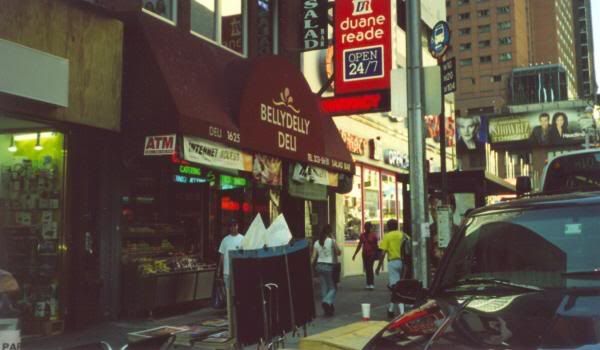
The BellyDelly Deli
looking up Broadway
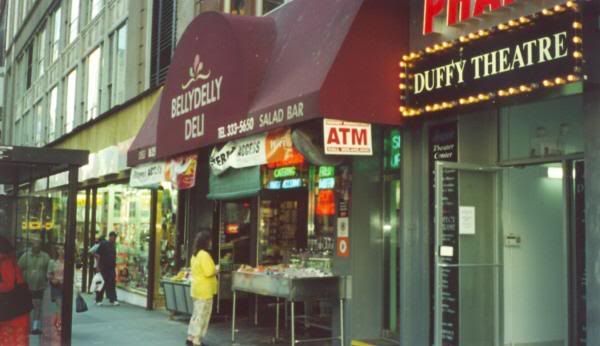
The BellyDelly Deli
looking down Broadway.
The BellyDelly Deli.
Cheers!
Thursday, September 01, 2005
Old, poor, and chronically ill in New Jersey
I take a deep breath and let it out ... once again ... and again ...
The mood swings of frustration and anger alternating with appreciation and euphoria through bouts of deep depression ... ebb and flow through my psyche as I deal with old age, poverty, and chronic kidney failure.
I get the feeling that most everybody has enough troubles of their own so I shouldn't be bothering anybody with mine. What am I, a wimp? "Suck it up and move on."
Well, in my circumstances, "sucking it up and moving on", is dying. So, if you don't mind, I think I'll explore some other options, thank you.
Let me describe the latest Catch-22 situation I find myself in. I was scheduled to have a surgical procedure this Friday, September 2, 2005, (like, tomorrow) which would allow me to go on in-home dialysis shortly. (Which to my understanding saves the State of New Jersey and Medicare a considerable amount of money over traditional dialysis, but I could be wrong--I'll ask for the facts next time. In any case, it leaves me far more mobile and actually will be better for my body, if I can be on it.)
I was doing all my pre-admission stuff and everything was on track--or so I thought--when I received a call on Tuesday, August 30, from the hospital's Financial Aid Office "reminding" me that I had an appointment with them the next day, Wednesday, August 31, at 10AM.
That was the first I had heard about any appointment with the hospital's Financial Aid Office ... and the communication deteriorated from that point on ... so I cancelled my procedure on Friday thinking the responsible thing to do would be to resolve the financial questions BEFORE I had the surgery. Because if it wasn't covered by some form of financial assistance on top on my Medicare A and B, then I had better rethink what I was getting myself into. (I have learned from experience that it is best to have these issues resolved ahead of time rather than afterward. I'm still paying off medical bills from 2002 that weren't covered.)
Anyway, I started asking questions about whether I qualified for Financial Assistance and they responded by telling me that I had to be committed to the procedure before they could give me that information.
Now, this sounded VERY strange to me. Here I have been reading all this stuff about the patient needing to "take charge of his/her medical care". So shouldn't I have the information I need to make a responsible decision? Like, can I afford what you're going to do to me? And shouldn't I have some kind of a reasonable estimate (like the range of possibilities) for what the outcome might be in terms of cost?
See, I had been going along thinking I was covered at this hospital, because I was covered at my other primary hospital, but, no, they said they couldn't tell me that ahead of time. The way I was understanding what they were telling me was that I had to accumulate the bills and THEN they would tell me whether or not the financial assistance program would pay them. How strange is that?
My first recourse was to contact the Social Services department of this hospital and review the situation. They basically told me that that was how this particular financial assistance program worked. When I replied that that put me between a rock and a hard place ... they offered to put me in contact with someone higher up in the Financial Aid Department. When I then asked if I could have something like a patient advocate to act as a mediator because otherwise I would talking to the person in charge of the rules which I was questioning. The Social Services response was that all they could do was refer me to the Financial Aid Supervisor. I told them that would be too stressful of a situation for me. They replied, "That's your choice".
I next went back to the surgeon's office. They informed me that I had to work it out with the hospital.
My next recourse was to share all this with a person in Essex County's Division of Aging. Here I began to make headway. This person and this department has been of great assistance over the past couple of weeks as I have been trying to sort out my health care options. She immediately responded and located a person in the hospital's geriatric department whom I can contact.
I went from frustration and anger to appreciation and euphoria, then settled into depression. I told the Division of Aging person how much I appreciated her help, and that hopefully I would have the emotional energy to pursue the contact by next week.
It's true growing old and being poor ain't for wimps. I'll let you know how "chronically ill" works out in the short run. In the long run, we're all dead.
The mood swings of frustration and anger alternating with appreciation and euphoria through bouts of deep depression ... ebb and flow through my psyche as I deal with old age, poverty, and chronic kidney failure.
I get the feeling that most everybody has enough troubles of their own so I shouldn't be bothering anybody with mine. What am I, a wimp? "Suck it up and move on."
Well, in my circumstances, "sucking it up and moving on", is dying. So, if you don't mind, I think I'll explore some other options, thank you.
Let me describe the latest Catch-22 situation I find myself in. I was scheduled to have a surgical procedure this Friday, September 2, 2005, (like, tomorrow) which would allow me to go on in-home dialysis shortly. (Which to my understanding saves the State of New Jersey and Medicare a considerable amount of money over traditional dialysis, but I could be wrong--I'll ask for the facts next time. In any case, it leaves me far more mobile and actually will be better for my body, if I can be on it.)
I was doing all my pre-admission stuff and everything was on track--or so I thought--when I received a call on Tuesday, August 30, from the hospital's Financial Aid Office "reminding" me that I had an appointment with them the next day, Wednesday, August 31, at 10AM.
That was the first I had heard about any appointment with the hospital's Financial Aid Office ... and the communication deteriorated from that point on ... so I cancelled my procedure on Friday thinking the responsible thing to do would be to resolve the financial questions BEFORE I had the surgery. Because if it wasn't covered by some form of financial assistance on top on my Medicare A and B, then I had better rethink what I was getting myself into. (I have learned from experience that it is best to have these issues resolved ahead of time rather than afterward. I'm still paying off medical bills from 2002 that weren't covered.)
Anyway, I started asking questions about whether I qualified for Financial Assistance and they responded by telling me that I had to be committed to the procedure before they could give me that information.
Now, this sounded VERY strange to me. Here I have been reading all this stuff about the patient needing to "take charge of his/her medical care". So shouldn't I have the information I need to make a responsible decision? Like, can I afford what you're going to do to me? And shouldn't I have some kind of a reasonable estimate (like the range of possibilities) for what the outcome might be in terms of cost?
See, I had been going along thinking I was covered at this hospital, because I was covered at my other primary hospital, but, no, they said they couldn't tell me that ahead of time. The way I was understanding what they were telling me was that I had to accumulate the bills and THEN they would tell me whether or not the financial assistance program would pay them. How strange is that?
My first recourse was to contact the Social Services department of this hospital and review the situation. They basically told me that that was how this particular financial assistance program worked. When I replied that that put me between a rock and a hard place ... they offered to put me in contact with someone higher up in the Financial Aid Department. When I then asked if I could have something like a patient advocate to act as a mediator because otherwise I would talking to the person in charge of the rules which I was questioning. The Social Services response was that all they could do was refer me to the Financial Aid Supervisor. I told them that would be too stressful of a situation for me. They replied, "That's your choice".
I next went back to the surgeon's office. They informed me that I had to work it out with the hospital.
My next recourse was to share all this with a person in Essex County's Division of Aging. Here I began to make headway. This person and this department has been of great assistance over the past couple of weeks as I have been trying to sort out my health care options. She immediately responded and located a person in the hospital's geriatric department whom I can contact.
I went from frustration and anger to appreciation and euphoria, then settled into depression. I told the Division of Aging person how much I appreciated her help, and that hopefully I would have the emotional energy to pursue the contact by next week.
It's true growing old and being poor ain't for wimps. I'll let you know how "chronically ill" works out in the short run. In the long run, we're all dead.
Subscribe to:
Posts (Atom)